
our bunnies for sale.
Upcoming litters due, Lionheads,, Netherlands s & Mini Plush. All raised indoors, and handled every day.
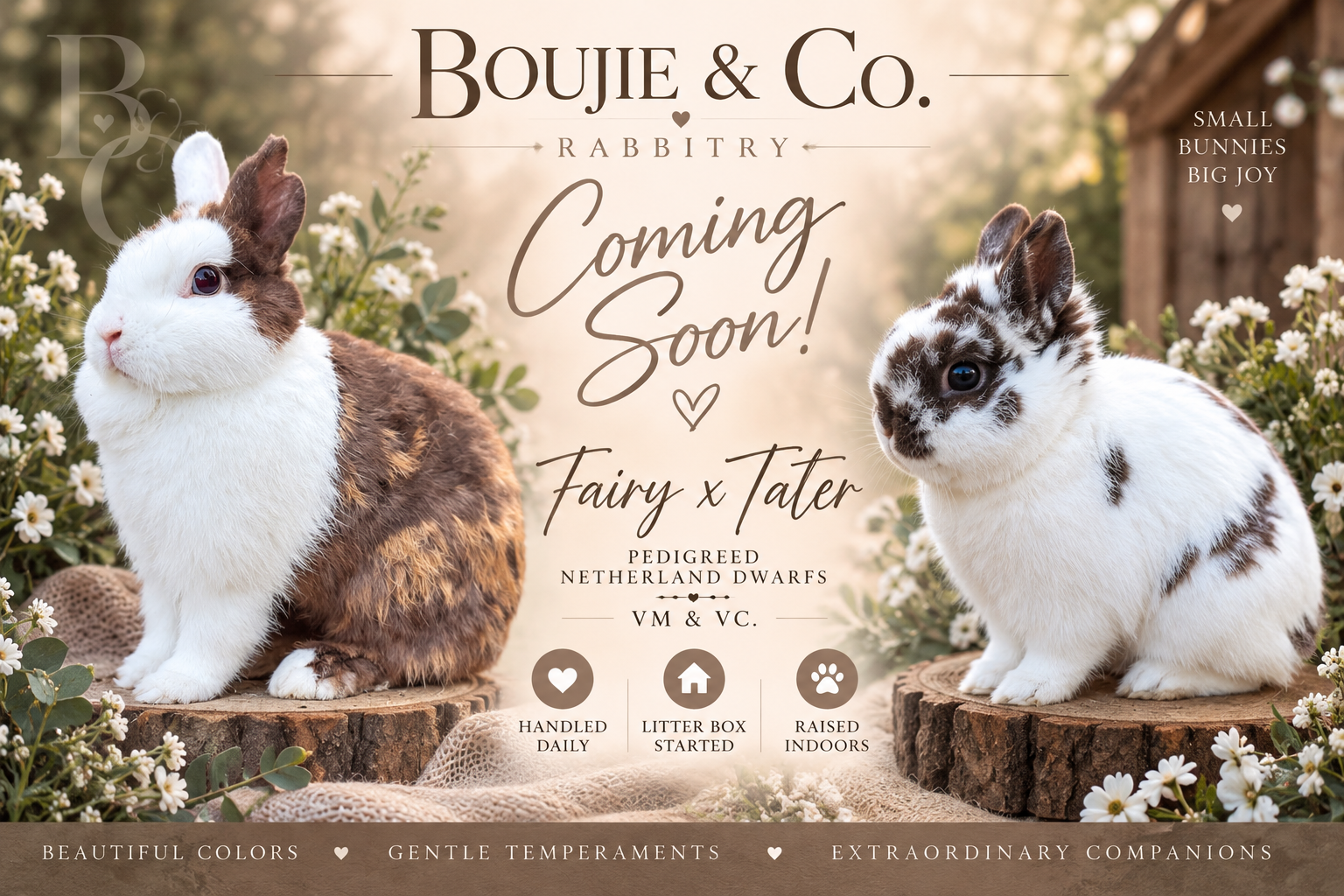
We cannot wait to see what this pairing produces! Fairy has always blessed us with large litters, and we’re hoping she does it again! 🤎
Fairy Dust is our beautiful blue-eyed, Vienna-marked Netherland Dwarf, paired with Tater, our handsome non-Vienna broken Netherland Dwarf.
🐰 For our breeders: We’re anticipating a beautiful mix of Vienna and non-Vienna chocolate broken babies, with some exciting possibilities!
🤎 For our pet families: Our goal is happy, healthy, well-rounded little companions with gorgeous markings, wonderful personalities, and, of course, the tiniest little ears!
We cannot wait to welcome these little ones into the rabbitry! 🐰✨
Frequently Asked Questions
-
A Holland x MPL is a cross between a Mini Plush Lop and a Holland Lop. We use this pairing to improve color variety and refine type within our plush lop program.
They are still adorable lop-eared bunnies and make wonderful pets with sweet personalities.
Estimated adult weight: 3–5 lbs
-
Mini Plush Lops are a newer, specialty breed known for their ultra-soft, velvety “plush” coats (similar to rex texture).
They are calm, friendly, and easy to handle, making them excellent pets for families and children.
-
Netherland Dwarfs are a very small breed known for their compact bodies, short ears, and adorable baby-like faces.
They are full of personality and, when handled regularly like ours, become very social and interactive pets.
Estimated adult weight: 2–3 lbs
-
Lionheads are known for their fluffy manes around their heads, giving them a “teddy bear” look.
We focus on double mane Lionheads with great coats and sweet temperaments, making them both unique and cuddly companions.
-
Vienna gene is what produces those stunning blue eyes you see in some of our rabbits.
However, breeding Vienna is not guaranteed to produce blue eyes in every baby. Some may carry the gene without showing it, while others will express it with bright blue eyes or unique markings.
Because of the time, effort, and selective breeding involved, Vienna rabbits are often more limited and sought after.
-
Our bunnies are handled from the very beginning of life, starting with gentle, short interactions as newborns to help them become comfortable with people early on.
As they grow, they are rotated between environments, including our indoor, climate-controlled bunny space (air-conditioned with heat when needed) and outdoor hutches. This helps them adapt to different settings with ease.
They are handled daily and exposed to normal household activity like TV noise, children, and everyday sounds, which creates well-rounded, confident little personalities.
Because of this, our bunnies transition very smoothly into their new homes and adjust quickly to their new families.
-
It means we have received a reservation fee for this bunny, but not the full payment. They are doing a local pick up.
-
Bunnies that have been paid for in full, have been marked as sold, and no longer available for sale.
-
Understanding Bunny Behavior & Acclimation 🐰
Rabbits are naturally prey animals, no matter how much hands-on socialization they receive from birth. Even a very well-rounded, confident bunny may behave differently when they leave our home and enter a completely new environment.
A new home means new smells, sounds, routines, people, children, and handling styles. Give your bunny time to acclimate and learn that their new environment is safe. We especially recommend that parents be the ones to pick up and supervise younger children around a new bunny, unless the child is mature enough to understand how to be calm, gentle, and properly support a rabbit.
Adolescence Can Change Behavior
Around adolescence, rabbits can go through a noticeable behavioral change. Hormones kick in, and a bunny that was incredibly easygoing as a baby may temporarily become more independent, territorial, energetic, or difficult to handle.
This is one reason rabbits are unfortunately so commonly surrendered or rescued.
Spaying or neutering can make a significant difference in long-term pet behavior. Rabbits naturally have a strong drive to reproduce, and hormones can influence behaviors such as marking, mounting, territorial behavior, and mood changes.
Around 6 months of age, we recommend connecting with an experienced exotic-pet veterinarian to discuss spaying or neutering and the appropriate timing for your individual rabbit.
Give Them Time
Rabbits need time to become comfortable with their surroundings, their people, and the way they are handled. Consistency is important. Everyone in the household should learn how to properly support and handle the bunny so they aren’t constantly experiencing different expectations.
Remember: being cautious doesn’t mean a bunny has a bad temperament. Being naturally wary is part of being a prey animal, especially during the baby stage.
And not every rabbit will want to be carried around constantly.
Many wonderful pet rabbits prefer being ground bunnies or lap bunnies. They may happily sit beside you, hop around the house, climb into your lap, or seek attention on their own terms but dislike being picked up repeatedly.
If your family is specifically looking for a bunny that has been intentionally raised for extensive handling, emotional-support companionship, and a higher tolerance for being held, look for a rabbit specifically raised and advertised for those qualities such as ESB.
A typical well-socialized pet bunny can still make an absolutely wonderful companion. The key is understanding that socialized doesn’t always mean “loves being picked up.” 🐰💕